


Were You One of the Thousands of Victims of These Hackers?

Vacations are supposed to be relaxing times of enjoyment with your family, away from the worries of everyday life. Sadly, for Emma C. and her family, their lavish vacation in Mexico took a terrifying turn. Emma and her family were attending a cooking class at a (supposedly) reputable business in the town of Oaxaca in southern Mexico. During the class, men with guns burst inside and rounded the whole class up in a storage closet, tied them up with zip ties, and told everyone to hand over their valuables.
Thankfully, everyone survived the ordeal, but many folks had lost everything valuable they had brought on their trip. As Emma and her family regrouped, they realized the thieves had left behind one of their cell phones, which they used to contact family members. In addition, Emma carried one of her credit cards separately from her wallet so the thieves didn’t find the hidden credit card. Essentially, with the one credit card and a working cell phone, Emma and her family were able to safely make their way back to their hotel.
Of course, no one expects these types of incidents to happen while on vacation, though I would personally avoid the country of Mexico as a whole. But, the thing is, travelers are common targets because they clearly stand out and are likely to carry more cash on them. So, whether you travel for business or pleasure I want to share some tips that can help you survive in the event that something tragic happens while on vacation like it did to Emma and her family.
“Men with guns burst inside and rounded the whole class up in a storage closet.”
Get to the Embassy. If you’re in a foreign country and you literally have no identification, no money and everything has been stolen you should attempt to make your way to the U.S. embassy. The embassy can assist you with getting a temporary passport as well as other services to help you contact family as well as your financial institutions. I would also carry around the embassy phone number on a different part of your body and not in your wallet.
Barter. When you have no money, you need to immediately begin bartering for whatever you need whether it be food, water or a ride to somewhere. For example, are you wearing a pair of brand new Reebok’s?
Perhaps a local would trade you for some less fancy shoes and some food? Also, if you have any skills that might be useful to locals, try to earn a little money or food in exchange for your work. Frankly, depending on where you are, you may even be able to find a farmer who just needs some manual labor done if you find yourself in a really bad situation. Contact your travel insurance. As soon as possible, contact your insurance company and let them know what happened. They will have a backup plan in place should a situation arise where you lost everything. They will also help you with obtaining money for your trip as well as helping you get the necessary documents to get you home. With that in mind, don’t forget to take an inventory of everything you take on your trip before you leave. Most importantly, leave your valuable jewelry and watches at home as this will only draw attention.
Cancel your cards. Before going on a trip, you need to strip your wallet. What I mean is, you most likely don’t need your Costco card while on vacation so take it out and leave it home. Once your wallet is stolen you need to contact your bank and cancel all your cards. The fewer cards you have on you the easier this will be. When I travel overseas, I take my ID, Visa and American Express and leave everything else home.
Ask for help. While you may be scared to ask for help, the fact is, many churches and local governments have funds to help distressed travelers. I can assure you that if you are in a well traveled area that you probably won’t be the first person to be passing through with no money. So, try and find a safe haven such as a community center where the locals can help find you what you need.
Lastly, no matter where you are traveling, pack your suitcase like you will never see it again. In other words, don’t take anything that you can’t live without.
“When I travel overseas, I take my ID, Visa and American Express and leave everything else home.”

Uncle Sam issued me a very nice Samsonite hard-sided briefcase. The kind with the three number combination dials, flip open latches, and a nice cozy grip carrying handle. It had the genuine Samsonite logo exactly where it was designed to have it. It was identical in every way (color, size, material, trim, etc.) to one right off the shelf. The difference with this one was that it was tamper proof. Not tamper detection or tamper resistant, it was tamper proof. If opened right-side up, it would explode (or alternatively, it could be armed to release extremely caustic chemicals that would be sprayed on the contents and on whomever opened it). In either event, it would utterly destroy the case and most traces of the contents. I was also issued a regular Samsonite briefcase that was a regular one you could buy at a store.
There are three distinct levels of tamper and defeats in the world of international espionage: Tamper Detection, Tamper Resistant and Tamper-Proof. You are no doubt familiar with the shrink wrapping and foil seals on over-the-counter pain relievers. They claim to be Tamper Resistant, but they are not. I do not need to explain to you the many nefarious ways those products could be tampered with despite those “protective seals”. But, for example, consider how easy it would be to buy a bottle, take it home, tamper your heart away, then reseal it with the foil and a shrink wrap. Or imagine how some criminal could use a needle to inject contaminates into the sealed product. Those seals are not truly tamper resistant and are in fact, low level Tamper Detections.
The manufacturer’s efforts to protect the contents from malicious tampering with these two extra seals are what we call Level 1 Tamper Detection. Level 2 is Tamper Resistance, which means something is sealed in a manner that requires extreme measures to gain access and this access leaves uncorrectable and observable damage to the container. Level 3 is Tamper Proof. If tampered with, it violently self-destructs, destroying the container and all contents and will likely result in the death and/or dismemberment of people opening the object.
In my business, I am very experienced at designing and applying all three Tamper Defeat Levels, based on my needs. Let me provide an actual scenario where I had cause to apply all three Levels of Tamper Defeat on one mission. I was sent on a mission that required deep cover. We always assume that we are under 100% around-the-clock professional surveillance from the time we leave our U.S. based covert ops staging building until we return. Usually, we know we are not under surveillance yet, but it helps us live our cover 24/7. When I say 100% surveillance, we understand that to mean: audio, video, surreptitious entry into our living spaces, clandestine searches of our bags, clothes, and vehicles, GPS tracking and other forms of electronic tracking.
“Usually, when I first arrive in a country, my first step is to test to see if enemy agents are on me.”
On this mission, my cover was that I was a U.S. businessman arriving in the target country for purposes of marketing and market development. I flew business class, had my pocket litter (business card, office keys, etc.) and career-appropriate magazines (with subscription la bels for my cover name and cover address). I also had my directories of local businesses and names of local business persons who I planned to meet with.
Usually, when I first arrive in a country, my first step is to test to see if enemy agents are on me and to see if they will expose their presence by tripping any of my tamper devices. I start by sloppily leaving my clothes, luggage, bags, passport, cash, etc. hurriedly tossed in place in my room. I quickly change clothes and head out for a meal. However, I am putting on a show to conceal my actual activity. I leave my zippered bags seven zipper-teeth from closed (I do vary that number). I toss my passport (where I am allowed to retain it — otherwise I leave plane tickets, travel itinerary etc.) in the top drawer with my US currency folded in half (upside down, with fold on the left) with the top edge of the bills cutting the word “Passport” (or its equivalent substitute) exactly in half.
I sprinkle a little foot power on my travel-weary feet as I am changing socks; some of the powder gets on the floor. There are several other special indicators that I have rehearsed and am able to apply or install with casual movements. Note: None of these are discernible behaviors or “tactics” that would be detectable by cameras (or microphones) hidden in the room, walls, vents, TV, or viewed through a window. These are Level 1 Tamper Detection methods.
Moving ahead, I want to see if I am under surveillance and if they will take the bait of Level 2 tamper devices. I want to test any potential adversaries and see if they are will-ing to manhandle a “secure” travel pouch with a lock. I keep a substantial amount of cash in that pouch along with emergency contact info for my (cover) family, friends and work place. So, if they do get into it, there will be no incriminating materials, but it will be clear that I have surveillance on me.
“I want to see if I am under surveillance and if they will take the bait of Level 2 tamper
devices.”
At this point, I am ready to begin my operation. Most of my espionage missions required sophisticated technology and devices. You cannot go through customs with most of those items so you have to have a way for them to be available to you when you arrive at your target ops area. In this case, I loaded my required tradecraft technology, mechanisms, etc. in my custom Samsonite briefcase that I would swap out for my sanitized Samsonite near the ops area after I had confirmed the absence of any surveillance. It would replace the sanitized Samsonite that I had been keeping with me at all times. In the event that I missed the surveillance or that some other event (random mugging, crooked cop, etc.) meant my special Samsonite with my spy gear fell into the wrong hands, they would undoubtedly detonate it. Then, I would follow my escape route to be quickly extracted out of the country.
You might be wondering, how I get my special Samsonite case in the target country? The old Shell Game. I leave the US carrying an identical off-the-shelf Samsonite briefcase. I keep that case with me from the moment I leave the operation prep site until I have been in the target city long enough to deter-mine that I am free of surveillance. At that point, I follow the pre-arranged protocol to schedule and conduct a clandestine equipment swap.
I look for the signal that the ex-change is ready and that my local team member has determined that it is safe to proceed. I respond with covert signals that indicate when I want to do the exchange. After that little dance is finished, we either conduct a Personal Meet (PM), Car Pick UP (CPU), Dead Drop or even a clandestine and discreet version of a brush pass to make the swap. That scenario is repeated in reverse after I complete my op. All is well that ends well – unless you end up opening the briefcase right side up.
Now, I fully realize you likely won’t be going overseas on a covert operation. However, if you travel and stay in hotel rooms, you may want to see if someone is entering your room and going through your belongings while you’re gone. You can take the simple measures of leaving your money a certain way or your lug-gage zipper open a certain amount, like I did. This will quickly allow you to know if someone is trying to “break into” your gear.
As more Americans choose to carry concealed, there is a growing demand for ankle holsters. After all, depend-ing on the clothes you have to wear for work, carrying on your ankle might be your only choice. Here are three differ-ent holsters you may want to check out.
Galco Ankle Glove. This ankle holster is very popular among law enforcement officers who carry a back up weapon. It’s made in the USA from saddle leather and sheepskin so it’s extremely durable. In addition, this will fit ankles up to 13 inches in diameter and has a thumb break retention strap. De-pending on the gun you own this sells for about $100 on Amazon.
Blackhawk Ankle Holster. One of the nice things about the Blackhawk is that it has a strong grip on your ankle due to the calf strap that helps keep the holster tight. The holster is made from plastic but is covered in cell foam that helps absorb sweat. It also includes a thumb retention strap to secure the fire-arm. This holsters sells for about $40 on Amazon.
Uncle Mike’s Off-Duty Ankle Holster. This is a very comfortable holster made from cordura nylon that’s designed for all different sizes of handguns. The soft knit fabric helps absorb sweat and is comfortable enough to be worn right against skin. Another advantage is that it has a removable calf strap so you can try it with the strap or without to find what fits you best. Lastly, the retention strap is made of nylon with a thumb break for security. This sells for around $30 on Amazon depending on the specific model.

There are a multitude of reasons why people have trusted gold and silver for the last few thousand years. In today’s world, you can cover the majority of gold and silver investor mindsets in just three categories:
The Prepper: He is preparing for a worst-case scenario where the dollar collapses and we may have to trade gold and silver for food and everyday services.
The Opportunist: He is investing in gold and silver in order to try and survive and thrive in this volatile investment landscape where interest rates are near historic lows and the stock market bubble could burst again at any moment.
The Realist: He is investing in gold and silver because historically, it has been one of the best places to protect and grow assets in times of uncertainty.
No matter which category or categories you fall into, here is a simple and easy way to understand which gold and silver coins you may want to invest in.
Bullion: The first category is bullion. It consists of coins and bars that trade very near the daily spot price. Historically, bullion has been an excellent hedge against inflation, stock market instability, currency devaluation, and is a consistently sought after safe-haven in times of global unrest. It is extremely liquid and, in some forms, can be held inside of an IRA or other qualified plan. Gold bullion has far outperformed CDs, the DJIA, the S&P, and the NASDAQ in the 21st century. (Gold bullion rose over 3600% from 1970-2017!)
When it comes to gold and silver bullion, I recommend United States mined and minted Gold and Silver American Eagles for all three categories of investor. While gold and silver bars can sometimes be purchased for a few dollars less, I prefer the recognizable and globally accepted U.S. minted and government backed coins.
RGIs: The second category is Rare Gold Investments. This category consists of investment grade gold coins that have value above and beyond the gold within them. Due to consistent investor demand on these finite supply coins, they far outperformed gold bullion from 1970-2017… by more than double. They also significantly outperformed CDs, the Dow, and the S&P during this time and are valued as a hedge against inflation, stock market volatility, and even gold bullion volatility. Many RGIs offer the potential for maintaining or dramatically increasing in value, even when gold bullion goes down. The rare gold investment category is one of the most private and portable forms of passing wealth from generation to generation.
My top recommended RGI coins are certified and graded U.S. minted gold $20 Liberties, $10 Indian Heads, $5 Indian Heads, and $2.5 Indian Heads.
In the end, I recommend a diversified approach that will allow you to take advantage of the unique qualities of both categories. Why limit yourself to just one category when you can accomplish everything that a Prepper, an Opportunist, and a Realist are striving for in one hand-selected portfolio that is both diversified and balanced? Obviously, you need to figure out what works best for you, but make sure you’re diversified into gold and silver to protect yourself from whatever the future brings.
[Publisher’s Note: For questions about buying gold and silver coins you can contact Forest Hamilton directly at foresthamilton@universalcoin.com or call 800- 822-4653. Please know, if you purchase any coins from Forest, we don’t receive any compensation from him. We simply know he’s one of the good guys in the business that can be trusted.]

Close quarters combat is referred to by several different terms in self-defense such as “the clinch”, “trapping range”, “CQC”, “the inside game” and “in fighting”. This is the range where you are at a maximum distance of an arm’s length away from your opponent, but outside of the “skin on skin” range of grappling. Common tools in this range include elbows, knees, head butts, eye gouges, foot stomps, and shin smashes. “CQC” is what is called by many as the “elite” range, where you can fight outside of your weight class, which is why it is chosen by many special forces as the range to fight in. And, if it’s good enough for special forces, close quarters range is where you should be focusing on for self-defense for the following reasons:
The Amount of Options. The moves and tools used in close quarters range simply outnumber the amount of options in any other range of combat. There is only a certain amount of kicks, angles of punches, and even grappling tools used in the ranges other than close quarters range. It is clearly due to the close distance which creates more options.
Degree of Options. Because close quarters range presents many options, it also presents a variety of options to injure your attacker. You could try a punch to the throat, headbutt, foot stomp or knee to the groin, to name a few. These options give you a wide spectrum to inflict massive damage or simply use pain compliance when needed.
Easy to Learn. One of the reasons why law enforcement and military elite like this range is the fact that the range is easy to learn. How hard is it to smash someone’s face with a head butt, or to strike them with an elbow? Of course, there are proper body mechanics that must be taught, but they are quite simple, compared to the complex techniques seen in other ranges.
Size Does Not Matter. A great example of this is women’s self-defense. Close quarters range permits a woman who might be under 5’ and only 100 lbs. to severely injure a man who is 6’8” and 350lbs. using the leverage close quarters tools gives the practitioner. Even “weaker” people can inflict massive pain in close range. Imagine catching a knee in the groin from an 80-year old fragile lady!
No Second Chance Needed. People get up from punches, kicks and get out of many submissions holds. Your attacker is definitely less likely to get up from head butts, elbows to the temples, knees to the low line, or even continue fighting after a bite or eye gouge. This is why I highly encourage you to focus your self-defense on this close range and avoid training (for now) on any other ranges until you’ve mastered CQC.
[Publisher’s Note: For more information about becoming a Spy Black Belt Certified Instructor, visit www.SpyBlackBelt.com.]
Have you ever heard your cell phone ring and when you look at who is calling it shows your own phone number? Unfortunately, this is happening more and more and it’s nothing but criminals stealing your phone number and using it to make thousands of phone calls.
A while back, a Colorado woman opened up a small towing company in Colorado Springs. Of course, as she was preparing to open her business she spent roughly $5,000 on advertising and printing all of her business stationary, including business cards, with every item listing the phone number for the business. The first day of business she received hundreds of phone calls. Normally, that would be great, however, these phone calls were mostly from angry people who claimed this woman had called them since her business number was appearing on their caller ID. In other words, someone was calling thousands of people and spoofing the caller ID to show the towing company number. In short, the scammer was making robocalls and trying to get people to sign up for a timeshare.
However, it was simply a scam to collect personal information from victims, who were all upset with the towing company since they thought it was them making the calls. Obviously, this was negatively affecting the towing business so the owner filed a complaint with the FCC. The problem is, this type of scam is very difficult to trace and stop. In fact, the laws regarding caller ID spoofing can be confusing. According to Mark Wigfield, an FCC spokesman, “Caller ID spoofing for malicious purposes is illegal.” However, he stated that a case of a victim of domestic abuse calling from a shelter and trying to disguise their location, clearly wouldn’t be illegal.
To make matters worse, it’s very difficult to stop someone from using your number There are companies that offer the service of making robocalls for telemarketing and they oftentimes pick random phone numbers to spoof. In other words, if you are a victim of caller ID spoofing, it could just be a random selection. However, if you do become a victim of this caller ID spoofing (like a friend of mine recently did) here are a few steps you can take if your number is being used.
Never answer a number you don’t know. All of us receive phone calls from numbers we don’t recognize, such as a doctors office, or even a company we may have done business with. The thing is, many caller ID spoofers will call the phone number they plan to spoof to make sure it’s an actual working number. When you answer and say hello they simply hang up since they know the number is legitimate. The way I look at it is if someone really needs to get a hold of me they will leave a message and I can call them back.
Set up a voicemail password/greeting. Most people forget that you can check your voicemail on your cell phone by calling it from a different number. Scammers know you can do this and they will oftentimes try to access voicemail to learn personal information or even change the greeting. In addition, if you are the victim of someone spoofing your phone number you may want to change your voicemail greeting to state that your phone number has been compromised. This will let people know you aren’t behind the spoofing scam.
Contact your provider and the FCC. If you believe your phone number is being used by these scammers, you should call your cell phone provider and alert them to the situation. Most major cell phone providers can offer spam blocking or spam detection, which can help reduce the chances of you falling victim to caller ID spoofing. What’s more, if you find out your phone number is being used you should report it to the FCC. Even though the FCC won’t be able to stop the problem you want to make them aware so that they don’t receive complaints about you and then think you are the one operating the scam.
The reality is, our phones expose us to many opportunities for criminals to take advantage of innocent victims, and Caller ID spoofing is only going to increase in the near future. Don’t forget, if you do answer a phone call from a number you don’t know, never answer any questions, hang up immediately, and if you notice that the phone number that keeps calling is your own number, you probably want to get a new number.

 Watch most any TV show where someone gets shot, and you’ll see that the number one way to save someone’s life after they’ve been shot is to dig the bullet out. They’ve been mortally wounded, but all you have to do is give them a swig of whiskey, and pull out the intact bullet, and they miraculously recover. The only problem with this is that nothing could be further from the truth.So, what then do you do with a bullet wound? It depends on where the entry and exit wounds are, whether they’re bleeding and how many times they were shot. The number one way you can stop someone from dying from a bullet wound is to stop the bleeding. The second way is to keep them breathing. If a person has taken a shot to the head or neck, there’s really not much you can do unless it is superficial. Assess the wound and apply pressure to minimize bleeding. If the wound is to the chest, again, there’s really not much you can do to stop the bleeding outside of an operating room because of the rib cage limiting access and exposure.
The next two areas are where you can actually make a big difference. If the wound is to the abdomen or pelvis, you need to hold firm pressure to the affected area. The pelvis may be particularly difficult but in the case of a pelvic wound, consider applying a makeshift pelvic binder in order to maintain pressure. This could be done with something as simple as a belt.
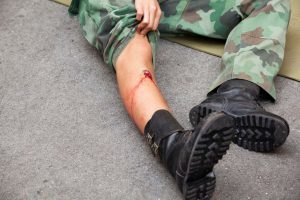 When the wound involves an extremity, it’s usually easier to stop the bleeding. If the bullet has not transected a major artery, superficial pressure is usually sufficient. However, if an artery is involved, it is imperative that you apply a tourniquet above the level of injury as quickly as possible. A tourniquet can be something as simple as a t-shirt and a stick that is used to tighten it around the extremity.
As far as keeping a patient breathing, all you really have to worry about is the face/neck and the chest. You must keep the airway open and clear of debris and blood. Sometimes this means rolling a patient to their side to keep the airway clear.
“If the bullet entered the chest, there is a high likelihood that the patient will develop a tension pneumothorax.”
If the bullet entered the chest, there is a high likelihood that the patient will develop a tension pneumothorax. The risk here is that enough pressure can build up inside one side of the chest that it limits the ability of the other lung to move air and also restricts the heart’s ability to pump blood. A tension pneumothorax can kill so you must consider putting another hole in the chest in order to relieve the pressure with a large bore needle just above the third rib under the middle of the collarbone on the affected side. If successful, you will hear a rush of air escaping and see that the patient is breathing easier.
The bottom line is, I certainly pray that you never find yourself needing to treat a gunshot wound, but these guidelines will increase the chance of survival until you can make it to a hospital.


