



Would you ever spend $130,000 on something and then, when it didn’t work, you’d just push it to the side? No? Neither would I. However, federal auditors looking into how Oregon spent counter-terrorism grant money found the state isn’t tracking purchases properly and some equipment they purchased didn’t even work.
Auditors found that a $130,000 emergency generator in Clatskanie, OR, purchased to be used in the event of a terrorist attack or disaster, was inoperable. The portable generator didn’t have the necessary electrical components to work. The Portland Bureau of Emergency Management purchased the generator for Clatskanie on January 25, 2017. The city manager said the city’s water plant couldn’t handle the electrical load produced by the generator. The building needed to be retrofit before the generator could be used.
Of course, this is just one of many examples of how governments big and small mismanage or simply waste our tax dollars. However, this is also a perfect example of why you shouldn’t buy a generator if you have no clue how to use it safely. With all of the grid problems lately and the power going out in places from New York to Alabama to Chicago, you’ve got to have some type of generator. It’s a no-brainer. As we’ve written about in the past in this newsletter, our adversaries (China, Russia, Iran, etc.) are constantly probing our grid and testing its vulnerabilities. They’re bringing it down in small increments now, but who knows when a huge lights out event will occur.
This is why you ought to consider looking into multiple types of generators including, solar generators. Here are the ins and outs of what you need to know…
How Does a Solar Generator Work?
As you’re aware, a solar generator harnesses the power of the sun to generate power. A solar generator is made up of two main components: The solar panels and the power generator. Solar panels are what converts the harnessed sunlight into electricity by removing electrons from atoms, causing the electrons to produce electricity. The power generator has two main parts, the inverter and a battery. The inverter turns the DC power from the panel into usable AC power. The battery simply stores any power that isn’t being used so you don’t just lose that power.
Why Solar Power?
The biggest advantage to solar generators over other options is the fuel. Sunlight is free and most of us live in places where we get sunlight on a daily basis, while other fuels may be difficult to come by during an emergency event. You may think you can stock up but you never know when you will have enough and, remember, gasoline could run out quickly during a disaster. The other thing is, if you store fuel, you will have to create a large, ventilated, secure space to store the fuel and you’ll have to put additives in it so it doesn’t go bad.
The Sun Shines
With a solar generator, if you run short on power one day, you confidently know that you can capture more sunlight the next day. Plus, the solar generator doesn’t produce any dangerous fumes like a gasoline generator. In addition, the sun is silent, meaning the solar generator is quiet, compared to the rumble of a gasoline generator that could easily give away your position or even attract others to your home during a disaster. When other people are without power, they will gravitate to someone who has a generator that they can use.
The Drawback
 The biggest issue when it comes to solar powered generators is that they cannot produce the amount of power needed to run an entire home. Solar panels on the roof of a home can be used to supply all the power needed for the home, but a portable solar generator won’t come close to that. The key to remember is that you want a portable solar generator for emergency use, meaning you will only want to use it to power the necessities.
As you can see, solar powered generators are a solid choice when it comes to portable generators for survival. If you are considering a solar generator, check out the ones made by Goal Zero and Rockpals, which you can buy on Amazon. For a more expensive option, look into the Inergy Kodiak 1100 Watt Power Bank Solar Generator. This generator includes an external battery bank connection, is lightweight at only 20 lbs. and sells for around $2,000 depending on the specific options you choose.

 The first goal is to reach the city’s edge and the plan starts at your residence, be it a house or an apartment. I am a big believer in firearms and knives being a part of the plan. Obviously, a firearm is the best defense against an assailant, but I always try to plan and foresee situations before they happen and prepare for them. So, in that case, I often have knives, mostly folders, duct taped all over the house in every room, just in case I need them to defend against an intruder. I keep them in spots where they won’t easily be found. (Remember, if you have children around, keep the knives out of their reach. Be responsible!) Obviously, if you are holding up in place for a bit, a good knife will be used to open cases of stored food, used to handle survival chores and even butter your biscuits, so it’s not just for defense, it is a critical tool in all situations.
You next must think about what you may encounter along the route. A good firearm will even the score if you run into some bad hombres, but remember, a knife will help in self-defense if you are trying to move with stealth and not be seen or heard. I like to carry several knives hidden on myself such as inside my boot or hidden on my belt so that I always have a backup. You may also want to have a good Leatherman Tool or Swiss Army Knife with you in case you need to break into someplace for supplies or safety or possibly use it to hotwire a car or fix something that breaks on you.
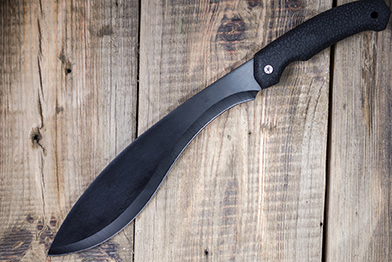
Having a good tool like this will come in handy if you need to cut wires or fencing along the way or open a much-needed snack of canned vegetables. If you have practiced and run your evacuation route (do dry runs ahead of time), you should already know some of the issues, but it’s hard to plan for the unexpected so it’s always better to overthink your needs in this situation. You may want a Kukri or machete in case you need to cut through some thick vegetation to avoid some bad characters along your route. A large blade is a very intimidating thing to be holding when someone may be sizing you up as a potential target.
Bottom line, a good rehearsed plan, your equipment, firearms and especially the knife, will play a huge role in survival in the wilderness and also in the urban jungle when the SHTF. If you take this type of thinking and planning and apply it to your “Get Out of Dodge” plan, it will pay off when you need it most. As I always say, you need to “Train As You Fight” with everything you do, so that you build confidence with your plan and see the challenges and issues before they arise. A good rehearsed plan always helped my units get out of sticky situations in combat and always proved to be the difference in success and it will do the same for you.

 If only small parts of the brain are affected, the person may not lose consciousness, but may have confusion or impaired awareness of their surroundings. This occurs in something we call focal seizures and can result in someone staring into space or being “stuck” in repetitive movements or actions. When larger parts of the brain are involved, awareness is most always affected and many times, there is also a loss of consciousness. When these seizures stop, the involved individuals are usually confused and it takes several minutes for them to understand where they are and what has happened. Types of seizures in this category are absence (staring/unaware), tonic (stiffening), clonic (jerking) or tonic-clonic seizures (otherwise known as grand mal).
The only way to stop a seizure is to either wait it out as they are self-limited in most situations or administer intranasal, intramuscular or intravenous medications such as benzodiazepines like Ativan or Valium or antiepileptic medicines like Keppra, Dilantin, or Phenobarbital.
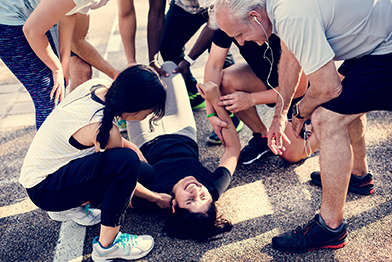
When someone is having a seizure, the best thing to do is be supportive. Make sure they don’t hurt themselves, make sure their airway stays open and they can breathe. If you have a long rubber or wooden bite block and you can safely insert it between their teeth, it may help prevent tongue injury. Don’t use anything they may swallow and don’t get bit. Make sure nothing falls on them and make sure they don’t fall.
You should seek immediate medical attention if the seizures last more than 5 minutes, are recurrent and won’t stop or if there are injuries caused by the seizures. Also, if breathing or consciousness doesn’t normalize within a few minutes after the seizure stops or if the person having a seizure has a high fever or is suffering from heat exhaustion call 911.
Many times, we don’t find anything significant and just don’t know what caused the seizure. However, when we do find a cause, it may be that they had a head injury, a brain tumor, a brain bleed, a stroke, metabolic problems, or heat stroke. If a seizure is one and done, the patient may never need medication. However, if the seizures are recurrent, the physician will most likely prescribe medications to prevent recurrence. If you’ve had a seizure, you should not take part in dangerous activities for at least 6 months. That means no driving, no swimming alone, no climbing on ladders, etc. If you have a seizure while you are doing any of these things, you risk severe injury and even death, and if you are driving, you will place the lives of others at risk as well.

The realm of international espionage operates under a strict training and elimination architecture. Many of the training modules are rated with the simple nomenclature “Satisfactory” or “Unsatisfactory.” If for some reasonably excusable cause an otherwise good candidate is rated as “Unsat” in a particular segment of a training module, they may be extended the opportunity to repeat the training segment and be reevaluated. But, this mercy is rarely granted and almost never granted a second time for the same person. Hence, an “Unsat” rating in a training module will be a failure and result in removal from the program.
One such Pass/Fail module has been portrayed in many spy movies. It’s the scene where the spy candidate is sent into a bar to pick up a specific woman or man. It is essentially a field exercise to test an operative’s elicitation skills. While we did do that as part of the elicitation module in training, we had a few even more challenging elicitation exercises called the Pick-up/Break-up and the EEI’s.
In my assigned Pick up/Break up evaluation, I was sent into a gay bar with the mission of “picking up” a man and getting him to go home with me while I was under direct and indirect observation. One of the trainers entered the bar before me and established an OP (observation post or position) and one of the trainers was outside in the parking lot to observe and record what happened when we came out. Picking up a person in the bar was the easier part of the field test. The harder part is what we call the Termination (no, not lethal).
The operational cycle of a HUMINT mission is the Spotting, Assessing, Development and Recruiting and Transfer/Termination (SADR/T). So, in this training scenario, the second phase of the mission is to “dump” the pick-up just outside of the bar. The test here was to see if I could abruptly terminate the relationship with minimal or no drama or outbursts.
But, for most of us, the hardest field elicitation exercise was the challenge of getting someone’s PIN, birthday, partial SSN, banking info or other highly protected information. In my training cycle, we were sent into retail establishments in malls. Our trainers would pick out a store and then instruct us on what information they wanted us to return with. Since in the real world we have time to do some casing, observation and other techniques to increase rapport, we were given great latitude and could select the individual we wanted to approach.
For example, we were sent into a music store and instructed to return with either the birthdate or PIN number from someone or the store’s security alarm code. If we could not ascertain either of those (remember, we were in a store in the mall where people were running errands and not at a cocktail party chatting away for hours) we could return with other information such as phone number, maiden name, etc. And, if all else failed, the trainers would accept an address, make and model of car, hobbies, etc.
You might be wondering how the trainers tested and confirmed the intelligence collected from the targets by the spy candidates. You also might be asking yourself how we pulled off stunts like this since American Foreign Intelligence Operations Officers are legally barred from spying or even collecting information from US Citizens.
We (officers in the Intelligence Community) have liaisons with federal law enforcement, most often FBI or Secret Service. Anyone that any candidate asks questions of receives an immediate (more like instant) visit from a badged and credentialed law enforcement officer. Depending on the status of the candidate, the officer identifies him/herself as a Federal Agent, displays their badge and credentials and informs the individual that they are not in any trouble but they need to answer a couple of quick questions for their own safety.
 The next phase of the interview goes like this: The Agents will tell the interviewees that the encounter was part of an authorized US Government training program. Then they ask the interviewee to recount the entire encounter with that trainee. They ask very specific questions to determine what, if any, personal information they provided the trainee. As part of the review and assessment of the candidate’s elicitation, the Agents also ask questions like “did it feel like a normal, comfortable conversation? Did you feel like they were trying to get you to tell them things? Did they make you feel like they could be your genuine friend?”
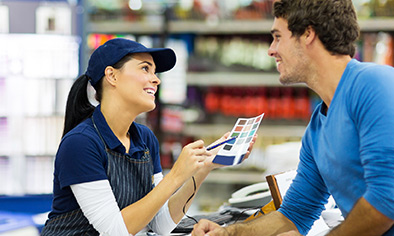
Here’s how I was able to get the clerk’s PIN during that particular training exercise. I started off by looking over at the clerk as soon as I entered the store. I gave the clerk a casual smile and even a little hand-wave gesture. Then I just started looking around the shop for a minute or two. Next, I approached the clerk and asked for help finding a particular title. While accompanying her to look for the title, I engaged in some light, non-invasive conversation. I then let her return to her checkout stand. A few minutes later, I briefly stopped by the counter and asked some kind of innocuous question (I cannot remember what) and thanked her again for the help. Then I continued casually shopping.
When there was a moment that no one was in line and the store was pretty much empty of customers, I went to the check out. I thanked her again for her help and made some small talk and jovial remarks. When she rang up the total, I said “That’s wild!” She asked what was wild. I told her that the last four digits of the price were the exact same as my PIN. Then I said, “And the only way I can remember my PIN is that it’s my birthday.” She laughed and said “I use my birthday for my PIN, too.” To which I asked her if she was born in December of the same year I was born in. (This was a joke since she was clearly much younger than me.)
She said “No, I was born in July” and gave me the year. And then I said “No way! I have a baby sister whose birthday is (month and year she just gave me). And then I said, “don’t tell me your birthday is on the 15th!” I like using that day of the month because it’s easy for people who want to try and lightly conceal the actual day of their birth date to quickly calculate and say something like, “Nope, 10 days before that.” Yes, they actually believe they are protecting their private information that way. In this case, she just came out and said, “Nope, my birthday is on the 21st.”
So, by great luck and a little skill and training, I got both her PIN and her birthday. If there is any “trick” to this, it is that you have to be genuinely friendly, completely comfortable and confident and look at them like they are your best friend. Don’t rush the little conversation or they will instantly feel there is something sinister on the cusp. And as you get each piece of information, show no interest in it, but use it as a bridge for you to provide them with information about you. The more vulnerable you make yourself to them, the more willing they will be to expose themselves just a little. Sometimes just enough to get what you need. We call these provocative statements and questions. They are very useful in getting the information you need. Try it on your spouse, kids, co-workers, or even on a stranger. You will be shocked at how effective this approach is in gathering information, just remember not to use this for any nefarious purposes.

Recently, I have been covering the release of Project 20/20, our highly targeted approach to gold coin investing. While I am still extremely bullish on gold coins, I want to share with you some news regarding silver from a recent interview I did with one of the top experts in the country, Dr. Michael Fuljenz, who is excited for silver’s potential.
A number of mainstream investment banks and commodity market analysts also see fundamental reasons why silver ought to be higher. Three major banks have issued price projections of $18 for 2019: Bank of America Merrill Lynch, Natixis and ABN AMRO. In addition, the commodity market analysis group Capital Economics predicts $17.50 silver this year. Their reasons are fundamentally sound: Positive investor sentiment has driven higher bullion coin sales, while industrial demand has also risen and new supply has fallen slightly over the previous year.
Here are the supply and demand realities: According to the Silver Institute, global silver demand hit a three-year high in 2018, surpassing one billion ounces after falling just short of one billion ounces in 2017. At the same time, global silver mine production fell for the third straight year, falling 2% to 855 million ounces. Total new supply fell 2.7%, from 1,032.6 million ounces in 2017 to 1,004.3 million ounces in 2018, while demand grew 3.5%. That means there was a 34.2-million-ounce silver surplus in 2017 (surpluses tend to depress prices), while there was a 29.2-million-ounce shortfall in 2018. (Shortfalls tend to boost prices.)
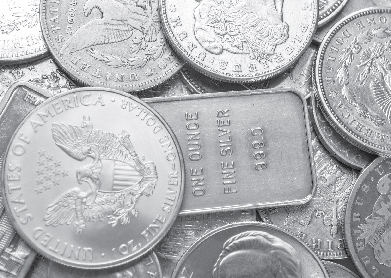 The biggest percentage increase in 2018, by far, came in demand for silver coins and bars, rising 20.5% from 150.4 million ounces in 2017 to 181.2 million ounces in 2018. This trend is continuing in 2019. In the first six months of 2018, for instance, the U.S. Mint sold 6,822,500 1-ounce Silver American Eagles, but in the first six months of 2019, Eagle sales grew by 47% to 10,022,000 ounces!
Turning to industry, silver has many industrial uses, accounting for more than half of annual demand worldwide in each of the last five years. Basically, when the world is growing, silver demand grows. Silver has the highest conductivity of any element for electricity and heat. It is valuable for soldering or brazing alloys. It’s used for batteries, medicines, nuclear reactors, photovoltaic (solar) cells, glass coatings, etc. These are many of the reason why silver acts like “gold on steroids” during a bull market in precious metals. With its huge undercurrent of industrial demand, there is a powerful floor under the silver price these days, so investors can buy silver with the assurance that the supply/demand curve will continue in their favor over the long term. [Publisher’s Note: For questions about buying gold and silver coins you can contact Forest Hamilton directly at foresthamilton@universalcoin.com or call 800-822-4653. Please know, if you purchase any coins from Forest, we don’t receive any compensation from him. We simply know he’s one of the good guys in the business that can be trusted.]

Awhile back, I was brought in by the Navy to simplify what the cadets were being taught along the lines of their self-defense. I focused on three moves that could help them fight outside of their weight, strength and even skill class, with minimal time invested in training. The other parameters of why I used these moves centered around a range of fighting known as “close quarters.” It is the distance just outside of grappling range and just inside of boxing range, so you are about one or two feet away from your partner.
This range is so powerful to learn because most fights and altercations end up there at some point. Take a look at a boxing match, wrestling bout, MMA fight or any street attack situation. Close quarters also hits on what I call the “trifecta of training”. Meaning, it is easy to learn, train and maintain. I’ve always had the opinion that if you can’t learn a move proficiently in under an hour at most, ditch it, because in a real-life situation it will probably be too difficult to remember. That is why all self-defense moves should be easy to learn.
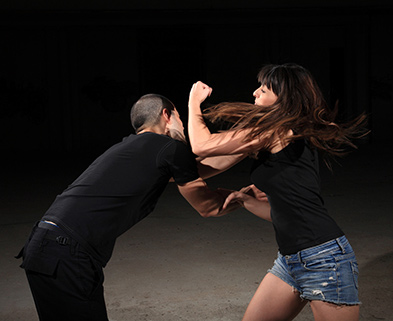 We tested these moves with a primary class of about 30 students, where I taught them the same simple self-defense moves that I will share with you here. The first move I taught was the elbow strike. To set this move up, you must bend your arm, raise your elbow above your head and then strike it in a downward diagonal angle. Using it against the opponent’s temple and side of face can cause substantial damage and even a knockout.
The second move is the headbutt. I know we’ve all seen Hollywood throw a million headbutts. But, we’re not talking about cocking our head back and then using our forehead to strike a target. Instead, what we’re doing in order to throw a proper headbutt is to use the top of our head by pulling an attacker’s face into it. In this case, we’re using the opponent’s softest, most vulnerable target, the face, against our hardest surface, the top of our head (not our forehead.)
Lastly, I taught them the knee strike. Launching a knee up into the groin or lower abdomen area is not only easy, but extremely painful to your attacker. This low line move can be used regardless of height differences and deliver incredible power from even the smallest practitioners. Simply firing your knee at a diagonal angle upwards, while leaning your body slightly backward for balance, is all that is needed to use this move defensively or offensively.
These moves are not the end all of self-defense, but can give you a solid foundation to fight off attackers of any size. Basing your foundation on close quarters moves gives you a lot of leverage in exchange for minimal training.


