



An unearthed treasure trove of KGB training manuals, once used to prepare Soviet intelligence officers, has recently been released to the public. Dubbed “The Lyubanka Files,” this was exposed by a group of reporters that dug into Russia’s history of espionage.
The documents from the 1970’s and 1980’s are still classified in Russia because they are believed to still be used in teaching tradecraft to current Russian spies. According to reporter Michael Weiss, the KGB was masterful at understanding the vulnerabilities and vices that went into running spies and agents. (I can certainly agree with this.) Weiss stated, “A KGB case officer was a combination of a priest, a therapist, a best friend and also a mortal enemy. He was somebody who was trying to get you to do things that would ultimately destroy you whether professionally or personally.”
One of the aspects of espionage that the Soviet Union mastered (and continues to do well) is creating lies and propaganda. For example, Operation Infektion, was a campaign carried out by the Soviets to try and convince third world countries that the CIA invented the AIDS virus as a means of population control. Of course, you and I know the Russians are still at it today, trying to influence presidential elections.
Considering that many of the tradecraft skills used in the 70’s or 80’s are still valid today, I want to give you a few ideas of what to watch out for. While you may not be the target of the Russian spies, criminals often use the same skills to get what they want.
Friendship. The beginning stages of the Russian recruitment process is focused on the principles of positive interactions like friendship or dating. This first step involves determining whether a person is a quality target based on his or her personality, occupation or connections.
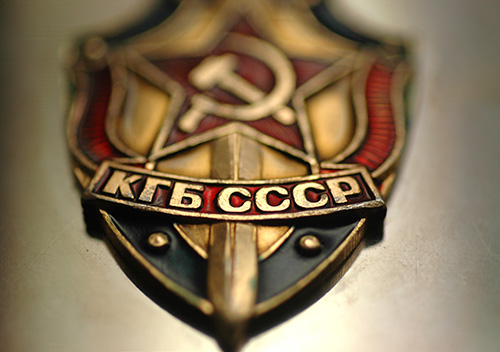 After initial interactions, Russian agents will dig deeper into perspective targets by learning about their background and probing to determine whether or not they would be willing to share any type of information they may have. The fact is, whether you just made a new friend or are on a first date, if people want to know too much about you too soon, they may have ulterior motives.
Your vice. In the 70’s and 80’s, Russians targeted Americans in embassies and would frequently focus on alcohol and affairs. They learned the biggest weaknesses of Americans were drinking and sex and they used these to gain information and as blackmail. As the saying goes, “Don’t do anything that you wouldn’t want printed on the front page of the Washington Post.” Fortunately for me, my biggest “vices” are guns, knives, flashlights and other survival gear.
The pitch. When trying to recruit someone, the last step in the process is to pitch to the person the idea of sharing private information. At this point, the person doing the recruiting will know everything there is to know about their target’s background, passions, financial situation and even their family. If someone ever approaches you and they know way too much, they are probably going to attempt to scam you out of a lot of money.
Obviously, it’s unlikely that your neighbor or mailman is a Russian spy who is targeting you for recruitment. But, like I said, there are so many cons these days where people are trying to scam people out of money, and these con artists work in the same fashion as Russian intelligence.

While I am not one to say I told you so, last month, I described the case for gold and silver to make a major move. Gold has recently surged to over $1,500oz, while silver has smashed through the $17oz barrier. So far, gold has primarily risen due to global currency devaluations in a “race to the bottom” among paper money currencies. This is separate from gold’s normal demand cycle, which is tied mostly to jewelry fabrication for holiday gift-giving in a variety of global cultures. September to February is the greatest time of the year for gold demand, accounting for virtually all of the price appreciation in the years 1975 through 2018. Gold’s average price change: March 1 to August 31 (1975-2018) = -0.15%. Gold’s average price change: September 1 to February 28 (1975-2018) = +6.05%.
 Gold is already up over $300 (+21%) in the past 12 months, largely due to the aforementioned global currency devaluation trend, so if it merely grows by the consistent historical average of 6% by next February, that’s over $1,600 per ounce! But, if nations continue to devalue their currencies over the next few months, gold could go even higher, above $1,700 or $1,800 or even into new high territory above $1,900, by the end of 2020. This typically results in many new and old customers buying gold with many of these buyers also entering the certified gold coin market.
In a bull market such as this, silver often outpaces gold. Witness silver’s rush to $50 in 1980 and $48 in 2011. In a past issue, I went on record predicting $18 silver this year and $20 next year when silver was just under $15oz. Silver has already surpassed $17, rising far faster than gold. And now we see a research report from the prestigious Bloomberg Intelligence commodity strategist Mike McGlone predicting $22 silver, even if gold doesn’t move much higher than the $1,500 range.
McGlone noted that silver ETF demand has reached a record high: “The 10-week rate-of-change in silver holdings at about 20% to August 15 is the sharpest gain since the height of the financial crisis in 1Q09.” He reminded investors that, “that spike in silver ETF inflows preceded the price launch to the 2011 high close of $48.44 an ounce.”
While he said that a run to $48 silver is unlikely, he did say “the yellow metal is only about 20% below its peak. Unless the trend reverses in ETF inflows, it should be a matter of time for new highs in the gold price.”
I truly believe that now is the time to buy gold and silver bullion and certified coins for survival, diversification, investment, and legacy purposes. Even if you don’t invest with me personally, please find a reputable dealer that is accredited with the BBB and has an A+ rating and get in front of this market wave! [Publisher’s Note: For questions about buying gold and silver coins you can contact Forest Hamilton directly at foresthamilton@universalcoin.com or call 800-822-4653. Please know, if you purchase any coins from Forest, we don’t receive any compensation from him. We simply know he’s one of the good guys in the business that can be trusted.]

I’ve had conversations with numerous law enforcement and military personnel who would much rather deal with a gunshot wound than slashes and stabs from a knife. Plugging up a bullet wound can be easier than the messy stabbing characteristics a knife can impose. But, at the center of this knowledge also lies how we can use a knife offensively.
When studying how to best use a knife offensively, you want to look at the environment where people have become masters in the craft: Prisons. Criminals have all of the time in the world to develop the best “shanks” out of the most unusual materials and figure out how to use them in the most cunning ways.
To train similarly and create a semi life-like environment, my team and I use two simple tools: White t-shirts and industrial-sized red magic markers. Sure, there is benefit to regular rubber training knives, but it certainly helps to see the results of the actions as well. Just like Simunitions show where the bullet hits, magic markers give an idea of what part of the body is being slashed and stabbed. Plus, it provides other information like how long a slash contacts flesh and how deep it could go by how big the ink mark is on the white cotton shirt.
 I’ve done this many times before, where I’ll have “experienced” martial artists show their knife defense against simple magic markers. After having red ink etched across their torso in several places, inside their arm and even across their forehead, they admit to the fact that what they’ve been using may not work.
So, what does work? What should you do to defend yourself? When facing off against an unarmed attacker, assuming you have a blade of some sort, the first step is to do an “X pattern” with your knife. This simple movement does a lot in a very short period of time. First, it helps you judge the amount of distance between you and the opponent. Next, it puts the attacker on the defensive. Lastly, it has them put up their hands. For this last point, it is not necessary that you actually cut them, but if they do sustain a cut on the arms, shoulder, face or neck, all the better.
The main point of having them raise their hands is so you open up another opening down low. After the “X pattern”, you need to close the gap in order to inflict the damage you need to get away and escape. To do this effectively, you put your empty hand arm over your face, with your elbow pointing out like a spear and rush into his centerline with your knife by your back hip.
This leads to the third and final step of using a “sewing machine” stabbing motion, as you stab into the abdominal area of your opponent. This move is taken from the prison shanking handbook. It is not only difficult to defend against, but almost impossible to stop. Yes, this may sound unpleasant. But remember, you’re only doing this if you’re forced to protect your own life or a loved one.
X pattern slashes, pressure with using your elbow as a spear and following up with several stabs in the “center mass” of the opponent is an easy and successful way of creating multiple problems for the attacker. It is not for the faint of heart, but could save your life if you ever need to do it.
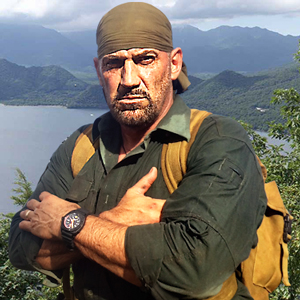
I remember serving in the city of Kirkuk in Northern Iraq, wearing a full combat load with heavy body armor, battle helmet, full uniform and the heat searing at a cool 140 degrees. So, it was critical that my soldiers stayed fully hydrated. It was such a huge task to keep that going, especially when they were on patrol deep in the city. They couldn’t refill from the local taps or wells, unless they used really good water filters, which had to be bought at personal cost. I remember never having an issue no matter where I went because I did buy a good water filter on my own dime. It was a great personal investment for me and a great insurance plan for always having good clean water to drink. I just wish I could have convinced the Army to buy one for every troop.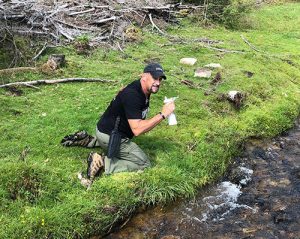 I often get asked what happens when this water crisis happens to civilians in a survival or natural disaster situation. My stance is no different whether you’re in Iraq, your own hometown or out in the wilderness. The law of 3’s for not being able to survive more than 3 days without water still applies, but rest assured, with a little knowledge and a good knife or tool, you can quench your thirst.
I always advise folks to try and jug up water and keep enough (1-gallon jug per person per day) on hand and be ready for an emergency. We have all seen the municipal water shutting down or getting a “Boil Alert,” making water consumption more difficult. I always tell folks that are preparing for a hurricane to fill up as many containers as you have in preparation and don’t forget to clean out the tub and fill it up too.
Also, always have ways to purify water, such as water purification tablets, camp filters and other methods. But, if these run out or you don’t have them, where else can you look? Right in your home, you can get water from the toilet tank, which is the section behind the commode, just make sure there are no chemical sanitizers in it. Never get water from the commode as it always harbors bacteria no matter how much you clean it. It might be good for Fido but not humans. The other is the hot water heater tank, which can hold 50 gallons or more of fresh drinking water. It is often over looked, but be careful and ensure it has cooled down before extracting it. I found that having a Leatherman handy for this task will help as there are several spots to open to get to the water inside and they will require different tools.
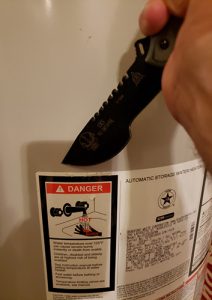
 Of course, there is always the brute force method using a good burly knife like a bowie to just pierce into the tank and start filling the containers that way. When using this method always make an opening at the top of the tank first to relieve any pressure built up to create an air hole so that when you make a hole towards the bottom, it will help with the easier flow of the water out of the tank. Avoid car radiators, as they contain poisonous anti-freeze. When it comes to your pool, there are arguments on both sides, but it all has to do what’s in the pool, as most people use chemicals to keep them clean.
You must use caution with a pool and may need to use several methods before consumption such as a combination of filtering, boiling, and distilling, to ensure enough chemicals and contaminants are removed to make it safe for drinking. I suggest using your knife to help cut up tarps or sheets to make a cover to try and eliminate future contamination. Ponds in urban areas tend to get treated with more chemicals than pools to ward off insects, they can get run off in them from surrounding areas with pesticides, fertilizers, and weed killers, as well as local pollution. However, knowing where local ground waters are located can be helpful such as streams and lakes.
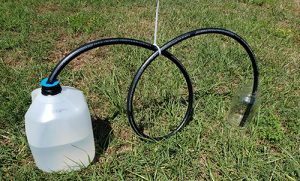
 Other methods should not be discounted, such as how to distill water in an urban survival situation. You can simply fill a container with water, place a bowl or a jar in the center, turn the pot lid upside down and gently warm the water. The water will condense on the pot lid and drip into the bowl or jar. It takes a bit of time, but will provide fresh drinking water and it’s a great technique for salt water or any questionable water sources. A Solar Condensation Still is an urban variation of the Ground Solar Still. It is a good alternative if you don’t have a yard and is simple to set up. Of course, you’ll need a good knife to cut and fit the pieces together and good sun exposure for it, but it works with time.
The bottom line is, clean drinking water is critical not only during war, but in any survival situation. Always remember the wilderness water gathering techniques as well, as they can also work in an urban environment, like rain and dew collection, tree tapping or using transpiration bags. Don’t rely on access to tap water provided by your local city to quench your thirst. Take your water needs into your own hands and be prepared for an extended period without fresh water.

My mission was to contact the person who designed the cyber security architecture for a prominent foreign power – a foreign power with world views in stark contrast with ours. Countless professionals had dedicated years of efforts to determine who was the brains behind this foreign nation’s successful information security architecture. The plan was to locate and have a conversation with this person at an exclusive retreat to see if they would work with the U.S.
One of the tools for such a conversation is “hourglass”. You start with an innocuous topic and guide the conversation to your desired data points. As soon as you get that information, you politely dismiss it as though it’s too detailed, confusing or something else. Then you move back towards a related, but distant topic, making sure that new topic is of the utmost interest to your companion. You keep moving away from the targeted information until you feel that they have entirely forgotten that part of the discussion. Now you have gotten what you need and cleaned the conversation so that it is non-alerting.
But, here’s what actually happened: At the opening of the cocktail party, someone announced the attendance of my target like this: “We are extremely honored and delighted to have among our world-renowned colleagues the distinguished (title and name).” My target stood, and everyone clapped and I watched to see who looked at him with hunger instead of admiration. There were four individuals, two teams of two.
 These four guys were obvious to the trained and experienced eye. I had this feeling that they did not just want to talk and assess him, but that they wanted to snatch him and take him home with them like a two-legged souvenir. My target was very alert and I could see that he was aware of their uncanny behavior and appearance. I watched as the evening went on. I could see them migrating towards him, ignoring everyone else.
So, I just acted off instinct. I walked over to where my target was entertaining a small group and put my arm around him and whispered, “Let’s get you out of here before they make their move”. He looked dumfounded and relieved at the same time. I laughed as I walked with him and shouted out in my best drunkard’s voice, “I’m done with my booze, where can I dump it out?” We took a turn and headed down a service hallway and I pushed him into a janitorial closet.
We waited, but no one came after us. That’s when I explained to him who I was. After about 40 minutes of talk, we had a tentative agreement. None of that was according to any plan. When I got back from the mission with deliverables, only one person voiced anger and threats of administrative action. He was blatantly ignored and the chief declared that it was a successful mission and the new asset would be handed off to the appropriate officers.
Planning and preparing is essential, but so is the ability and willingness to adapt. Do the ends justify the means? To answer that, you have to describe the ends and measure those against the means. Don’t fall for adages. Rely on your own ability to discern what is right and what you are willing and able to do to achieve a valid and noble goal. And, try to have as many backup plans as possible.

How? It is said that 50% of our health is dependent on the daily choices we make regarding our lifestyle, activity, risk and nutrition. Twenty percent is dependent on our environment, toxins, infectious disease, pollutants in air and water, etc. Twenty percent from our genetics, which we have little control over – yet, we do have more control than we think – and only 10% of our health is dependent on what physicians and surgeons provide us, mainly in the form of surgical cures.
 Let’s discuss genetics briefly. Genes are a code by which the body functions. They give us hair and eye color, race differentiators, gender, organ differentiation and physiologic differentiation. Everything we are is a result of our genetics. Yet, some gene expression is driven by the environmental factors they find themselves in. In other words, some genes express themselves based on what we eat and how we live. Those genes can be up-regulated or down-regulated by our choices. They can be turned on and off like a light switch based on what we eat, how we sleep, what we do for exercise, how fit we are, etc.
One of the primary determinants of how we live and how our health is benefited or destroyed, is what we choose to put in our mouths from day to day, minute by minute. What we eat and how often is probably the most important factor of how we live in our bodies. We know through tons of medical studies that reasonable calorie restriction benefits us immensely and increases our lifespans, and more importantly, our healthspans. Some elite athletes need 10,000 calories a day. Most of us need less than 2,000.
Also important to know is something called an insulin window. Know that the less insulin we force our pancreas to produce in a healthy state, the better off we are. Insulin is an anabolic peptide hormone produced by the beta islet cells in the pancreas that is necessary for glucose to be effectively transported across our cell membranes and stored in our tissues.
Insulin is a pro-inflammatory agent and a fat-storing agent. While it helps make us fat, it also acts like growth hormone in a negative way. Once we get our bodies conditioned to a high-carb, high-insulin state, unless we make radical changes to how we eat, it is nearly impossible to lose weight and to keep it off. We want to minimize the amount of insulin our body produces and the time in which it is being produced by eating in a way that minimizes the need for insulin. In other words, unless we are a professional athlete who needs a high carbohydrate load to function, we should be focusing on a low carbohydrate diet. In fact, we used to think that fat killed. It doesn’t. Carbs do. They are deadly in the way that we are using them in our diets today.
So, how do we calorie restrict in a healthy way, what mix of macros are best for our health (hint: it’s dependent on your goals), and what the heck is intermittent fasting? Then, how do we get in shape so that we increase our chances of survival and, even more importantly, our healthspan so that we can actually enjoy the life we live without disease and disability? That’s all coming in futures issues, I promise. But, for now, just know to go easy on the carbs and don’t eat a million calories a day.


