


If you’ve ever been concerned about home security or your family’s safety, then read on… because this may be the most important message you’ve ever received.
And believe me, as an intelligence officer trained to case buildings, I know a thing or two about what it takes to make a dwelling safe and secure.
I’m a former CIA officer, a security specialist and New York Times best-selling author of Spy Secrets that Can Save Your Life.
As an officer in the Agency, evaluating places for security weaknesses was a normal part of the job. So much so it’s become second nature to immediately spot holes in home security.
And there’s one device that can do more to protect a home from unwanted visitors than any other.
The No. 1 deterrent for most would-be burglars is having a camera on your property.
In fact, alarm.org reports that “nearly 60% of the burglars said they would consider the presence of cameras or other video equipment when selecting a target, and more than 40% said that would be a factor in prompting them to choose another target.”
When it comes to securing your home, your possessions and your family, projecting strength to potential bad guys is the best defense mechanism there is.
But there are other tips you can employ around your home to make it far too risky for anyone to attempt a break-in.
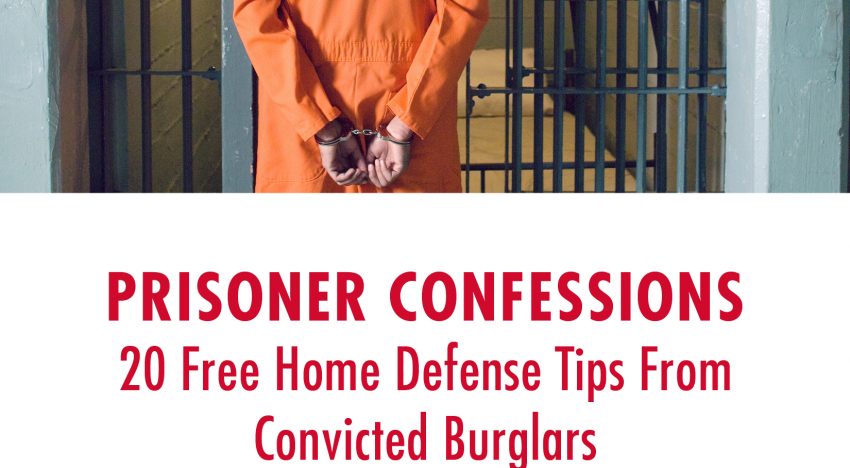
Over 80 convicted criminals were surveyed on what they look for when considering their target, so we have them to thank for these free home defense tips:
Get an alarm. You can go online and buy a blue ADT alarm sign and stick it in your front lawn, which is certainly a good idea. But obviously, it’s better to have the real thing. There are a lot of alarm companies out there, and the top-name brands are all pretty good. But keep in mind those uncreative criminals are getting smarter these days and will often cut your phone lines. Therefore, make sure the company offers a wireless backup for your alarm system in case the phone lines get damaged during an attempted break-in (most of them do).
Location of your alarms is key. Criminals don’t just use the front or back door… they often use windows. Make sure your security company puts sensors on first-floor windows, including the window over the sink, and second-floor windows — which often lead to high-priced items such as jewelry.
“Harden” your front door. Criminals aren’t exactly the most creative of people. The majority of break-ins and home invasions are through the front door. So make sure your front door is solid metal or solid wood. Have a deadbolt with a 1-inch throw bolt, along with a heavy-duty strike plate with 3-inch wood screws.
Also, resist the temptation to have a “pretty and decorative” glass front door. If you have one of these doors, all a criminal has to do is smash the glass and reach in to unlock your front door, which can be done easily in just a few seconds.
Be cautious of who you let in the house. That person who was cleaning your carpets, painting your house or working in your yard last week may not have been doing just that. Criminals will sometimes find a way to get an “in” and unlatch a window to make their return a little easier.
Get an alarm for when you travel. I recommend getting a door stopper alarm when you’re traveling with your family. This alarm is simply a wedge that you slip under a hotel room door, so if someone tries to open the door, an extremely loud alarm sounds. As an added bonus, the wedge makes the door difficult to open. Door stopper alarms are relatively inexpensive, costing only $10–15. I’d recommend the GE Personal Security Door Stop Alarm, available on Amazon.
Place a temporary stop on any mail delivery while you’re away. Yes, burglars really do look for mail piled up in the mailbox or newspapers piled up on the driveway. It’s a telltale sign that nobody’s home and the coast is clear. Or you can do what I do and use only a UPS Store mailbox for all mail.
Never answer your front door for strangers. Why? Because in some cases, as soon as the homeowner opens the front door, criminals jump out of the bushes and attack the homeowner. If someone approaches your front door needing help, offer to call the police for them, but do not open the front door.
Don’t open the door for anyone claiming to be a salesman or trying to pitch a survey. The fact is before a burglar plans on breaking into a house, they will often knock first to see if anyone’s home. If you answer, they’ll probably just ask for directions or try to sell you a vacuum (while at the same time “sizing you up”).
Whatever the excuse, don’t answer. If you’d like to help, give them directions through the door and tell them you don’t want to open it because it would set off your alarm.
Keep your travels to yourself. Do not announce your vacations or daylong travels on Facebook or any other social networking sites. It is a lot easier than you think to look up your address and find where you live from a simple Facebook post. Criminals know this and spend hours casing Facebook to see if anyone in their area posts that they’re taking a long vacation or are going out of town. Once a criminal sees this, they simply look up a person’s address and plan their break-in.
Remove the NRA (National Rifle Association) bumper sticker from your car. I happen to be a lifetime member of the NRA. But while you might think this is a deterrent… it practically begs burglars to break in. NRA sticker = guns to steal.
Know the most popular time for break-ins. Burglars prefer breaking in during the early morning or afternoon. Specifically 12:30–2:30, because most kids are in school and anyone who might’ve been over for lunch should be gone.
Keep your valuables locked up. The first place many burglars are going to look is the master bedroom. People tend to keep their valuables close to them. This is where a lot of jewelry and other expensive items, including safes, are kept. If you invest in a lockbox or safe, the best thing to do is to ensure it won’t get up and walk away. Safes that cannot be picked up and carried off, for example, may be bolted into the floor or wall.
Get a dog. Or even a “beware of dog” sign. Most burglars tend to stay away if homeowners have a big, loud dog. They are home protectors and a lot of criminals don’t want to bother with a road block such as this. Also, get a dog bowl to put at your back door.
Know your neighbor. Make yourself familiar with the people around you. That way, if anything seems a little out of whack, your neighbor will know to report any suspicious behavior.
Protect your home in bad weather. When it snows, a big signal that no one’s home is virgin snow leading up to the house. So if it snows while you’re out of town, get a neighbor to create car and foot tracks into the house, to give the idea that you’re home.
Keep an extra car in the driveway. Most of the time, a car in the driveway is a sure tell sign of someone being home. So as a homeowner, this is a great precaution you can take.
A loud TV or radio can be a great deterrent. Many burglars fear that someone might be home if they heard a TV or radio. If you don’t want to leave your TV on while you’re away, there are actually devices that simulate the flickering glow of real TV.
Arm up. Get a firearm. You may not want to carry concealed and have a firearm on you at all times, but you should definitely consider getting one for home defense purposes. (But don’t advertise this with an NRA bumper sticker.)
Install motion-sensor lights around your home. This is one of the most overlooked security measures. Even though you may have a porch light or back light, it’s critical that you don’t have dark areas around your house where a criminal can hide as they try to break into your house through a door or window.
If something feels off, it probably is. Many burglars do surveillance while looking for the best opportunity to break in. Who lives in the home? What are their weekly schedules? What kind of car do they drive? Do they have a dog? Is there a hidden key around the house?
Criminals are often watching. So if you sense that you’re being watched or a person is acting strange in your neighborhood, don’t be afraid to call the police and report suspicious activity.
I also want you to walk outside of your house and stare at all of the houses surrounding you. Look at the houses to your left, to the right, in front of you, and behind you.
Then ask yourself the following question: Of all the houses I am looking at now, if I were a criminal, which would be the easiest target?
It’s easy to do once you know what to look for.
Stay safe,
Jason Hanson


